


Hunting Down Vintage Norwegian Forest Cat Magazines and a Rare Danish Cat Plate
It started as a simple curiosity, then turned into a small paper chase across resale sites, private collections from friends and breeders, Facebook messages, and one very lucky connection in the UK. This post is only a few of the treasures that were easily at hand. I have others, a coin from the Isle of Man, Posters, and early cat club memorabilia to bring out another time.
I have taken up collecting vintage cat magazines and books that feature the Norwegian Forest Cat, partly because I love the breed, and partly because these old articles are easy to lose. Magazines get tossed. Captions get separated from photos. Breeders retire. Names fade. Before long, a little piece of cat history disappears into someone’s attic.
So I started hunting.

Why I started looking for these old articles
The Norwegian Forest Cat has such a rich history, and I wanted to see how the breed was written about at different points in time. Not polished modern breed summaries, but the actual articles people were reading when the breed was still new to many cat lovers in the United States.
That is what makes vintage Norwegian Forest Cat magazines so interesting to me. They capture a specific moment. The language, the photos, the breeder names, even the way the cats are described all tell a story.
I am not collecting them just to own them. I want to document the written articles, preserve what I can, and learn more about how these amazing cats were introduced, understood, and loved over the years.
Some of the pieces are harder to find than I expected. A few came from resale sites like eBay. Others came from private owners. The best finds usually did not happen through a neat search result. They happened because someone knew someone, or because I asked the right question in the right place.
The March 1979 Cats Magazine find
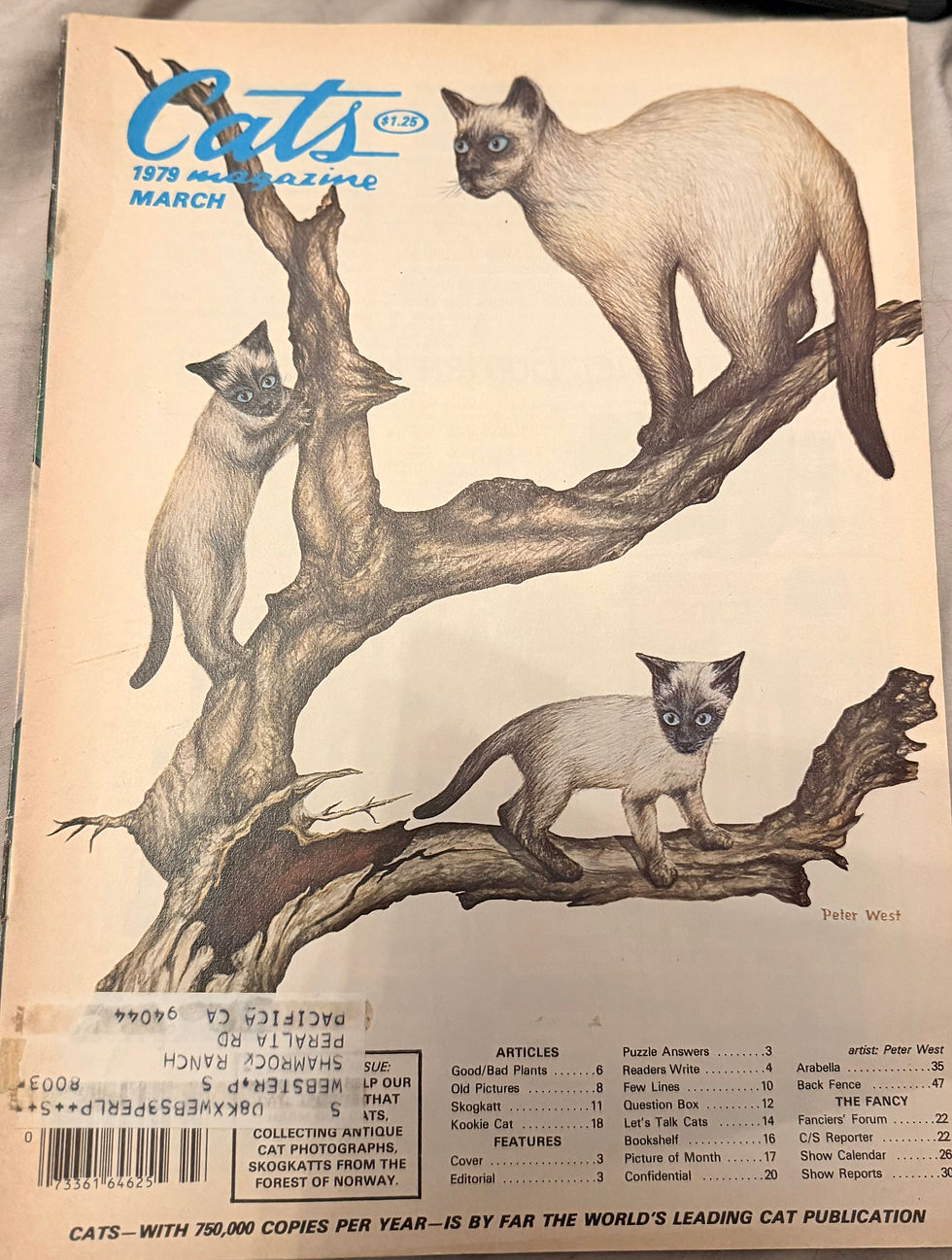
One of the articles I really wanted was from the March 1979 issue of Cats Magazine, written by Beverly Anderson.
The date mattered to me. The article lines up with the time when the first Norwegian Forest Cats came to the United States in 1979. That made it feel less like a random old magazine and more like a marker in the breed’s American story.
I first saw a photo copy of this article in a personal collection of a fellow breeder. I never imagined I would be able to find an original copy.Finding it was not as simple as typing a title into a search bar. I eventually located a copy in the UK through a cat magazine historian Sarah Hartwell, I found through Facebook. That was one of those collector moments where you think, “I cannot believe this actually worked.” I found a post where she was telling about the day she had cataloging years worth of Cats Magazine. I reached out to her to see if she had a copy of the article I could see. When she said she did and had an extra copy of the magazine, I was over the moon excited.
The issue had traveled through time, across owners, and across countries, just to land in my little growing collection. That is part of the fun.
It also made me think about how fragile this kind of history is. If one person had thrown away that magazine, or if one collector had not saved it, I might never have found it.

Cat Fancy, LostWoods Cattery, and other magazine pieces
I also discovered the September 1999 issue of Cat Fancy. With assistance from a featured participant, I located an article with photographs from LostWoods Cattery dated September 2005. Through the cat distribution system and TICA cat shows, I met LostWoods founder Lisa Vasa and her partners, Mark and Jill Baur. I had no idea we would form such a close friendship. I am incredibly grateful to have them in my circle. When Lisa mentioned that some of her cats had been featured in a magazine, it became the second must-have I was determined to find.
The later articles are interesting in a different way. By the 90's and 2000's, the Norwegian Forest Cat was more familiar to cat fanciers in the United States, but still special enough to be featured and explained. The articles often focus on the breed’s rugged look, heavy coat, history in Norway, and calm but confident personality.
What surprised me most was not what the articles said. It was what they left out.
In the majority of these articles, neither the cats nor the breeders in the photographs are named; only the photographers receive credit.
That really caught my attention. You can usually assume the cats belonged to breeders mentioned in the article, or were connected to the catteries being featured, but many of the cats and breeders remain anonymous. They are right there in print, representing the breed to thousands of readers, but without their names attached.
That feels strange now, especially in a breed community where pedigrees, photos, and names matter so much.
So, I began contacting longtime breeders in the USA to see if anyone could identify the cats. This became one of the most enjoyable aspects of the entire project. I anticipated a simple research task, but instead, I discovered engaging conversations, cherished memories, and generous individuals eager to assist in connecting some dots. Thank you to Brook Cole, Margie Nelson, Barbara Chronakis, Christine Antinbring, and Lisa Vasa for helping identify some of the cats. I hope to write another post about the articles in the future.
The out-of-print Norwegian book I hoped to find

The magazine collection also guided me to books, particularly one I had been eager to find for some time: Norsk Skogkatt by Paul Sveinall. The photographs are attributed to Tom Jensen, which is my maiden name, but it's a very common name in Norway. Yet, I can't help but wonder.......
The book, written in Norwegian and no longer in print, wasn't something I thought I would easily come across. I first browsed through a copy while visiting Norway. It was Ina Selte's copy, signed by the author, and after seeing it firsthand, I knew I wanted to eventually find my own. Initial searches yielded no results until a month ago. I had noticed the title on an online bookstore in Oslo but hadn't translated the page to discover it was available.
There is something special about a breed book written in the country tied to the cat’s identity. Even if I cannot read Norwegian , the photographs, names, and structure still offer clues. It gives context that English-language articles sometimes cannot.
And honestly, the fact that it is out of print only made me want it more.

The 1987 Danish cat plate
The collection is not only paper. I also found a limited edition cat plate created by Danish artist Carl Erik Fugl from 1987.
This plate fits beautifully with the magazine and book collection because it feels like another kind of breed artifact. It is not an article or a pedigree record. It is art, and it shows how cats were being celebrated in homes as well as in print.
I like objects that have that quiet collector feeling. A plate from 1987, an old magazine from 1979, a book from Oslo. None of them are flashy, but together they start to form a little timeline.
They also remind me that breed history is not only kept in official records. It lives in:
Old magazine features
Cattery photographs
Breeder memories
Out-of-print books
Art pieces and collectibles
Private collections that people cared enough to save
That is what makes the search feel worthwhile.

What this little collection has taught me
I began with a few delightful gifts, then started dreaming about what other possibilities existed. I believed the objective was to locate specific issues, examine the pages for information, and organize them.
But the process has become much more personal than that.
I have learned that preserving breed history often means asking around, following small leads, and respecting the memories of people who were there before online archives made everything searchable. A magazine from a private owner can matter. A blurry photo caption can matter. A breeder saying, “I think I know that cat,” can matter.
I have also learned to look closely at what is missing. The unnamed cats in these articles bother me a little, but they also give me a reason to keep asking questions. Maybe some can still be identified. Maybe some cannot. Either way, they deserve to be noticed.
For now, my collection is still growing. I keep an eye on resale sites, save references when I find them, and ask questions when I can. Each new piece adds another layer to the story of the Norwegian Forest Cat, especially here in the United States.
And if an old cat magazine can connect a cat lover today with breeders, historians, artists, and cats from decades ago, I think that is a pretty good reason to keep hunting.


Comments